The world of interior design is currently experiencing a massive shift. As we move away from synthetic, plastic-based materials and look toward sustainable, “breathing” homes, old-world materials are making a massive comeback. At the forefront of this movement is a finish that has been used for thousands of years: Distemper Paint.

But what is distemper paint, and why is it suddenly the talk of the architectural restoration and eco-friendly renovation world? In this exhaustive 2,000-word guide, we will peel back the layers of history, chemistry, and practical application to understand this fascinating medium.
1. Defining the Medium: What Exactly is Distemper?
To understand what is distemper paint, you have to look at its ingredients. Unlike modern “emulsion” or “latex” paints—which are essentially liquid plastics—distemper is a traditional decorative paint made from natural minerals and binders.

The Anatomy of Distemper
Every paint consists of three main components: a pigment (the color), a binder (the glue), and a carrier (the liquid). In distemper:
- The Pigment: Historically, this was “whiting” (crushed chalk or ground calcium carbonate).
- The Binder: This is the defining feature. Traditional distemper uses animal glue (size), hide glue, or sometimes starch and casein (milk protein).
- The Carrier: Pure water.
Because it lacks the complex chemicals found in modern paints, distemper is often referred to as “soft paint.” It creates a finish that is uniquely matte, absorbing light rather than reflecting it, giving walls a soft, velvety depth that synthetic paints simply cannot replicate.
2. A Journey Through Time: The History of Distemper
Distemper is not just a paint; it is a piece of human history. To truly answer what is distemper paint, we must look at where it came from.
Ancient Origins
The use of distemper dates back to the Ancient Egyptians, who used a mixture of pigments and gums to decorate the walls of tombs and temples. Because the climate in Egypt was so dry, these water-based paints have survived for millennia.
The Renaissance and Beyond
During the Renaissance, distemper was the standard for “temporary” or “decorative” painting. While fresco was used for permanent church walls, distemper was used for stage scenery, posters, and the interior walls of residential homes.
The Victorian Era and the “Poor Man’s Paint”
In the 18th and 19th centuries, distemper became the most common wall finish in Europe and North America. It was incredibly cheap to produce. Homeowners would buy bags of whiting and cakes of glue, mix them with water over a stove, and apply the mixture themselves. Because it was so easy to wash off and re-apply, it was used to keep homes looking fresh and “sanitary” before the invention of washable wallpapers.
3. The Different Varieties of Distemper
When people ask what is distemper paint, they are often surprised to learn there are two distinct versions. Choosing the wrong one for your project can lead to maintenance headaches.
A. Soft Distemper
This is the “purest” form. It consists only of chalk, water, and size (animal glue).
- Pros: It is the most breathable finish available. It is also very easy to remove—you just need a sponge and warm water.
- Cons: It is very delicate. If you rub your shoulder against a soft-distempered wall, you will likely get a white chalky mark on your clothes. It cannot be washed.
B. Oil-Bound Distemper
As technology progressed, decorators began adding a small amount of drying oil (usually linseed oil) and an emulsifier to the mix.
- Pros: This makes the paint much tougher and “wipeable.” It doesn’t rub off on clothing and is more resistant to moisture.
- Cons: While still more breathable than modern acrylic, it is less so than soft distemper. It is also harder to remove when it comes time to redecorate.
4. Why Distemper is Making a Comeback: The Benefits
In an era of high-tech coatings, why are we returning to a paint that “chalks” and can’t be scrubbed? The answers lie in health, heritage, and aesthetics.
1. Breathability (The “Damp” Solution)
If you live in a house built before 1920, your walls are likely made of stone, brick, or timber and finished with lime plaster. These materials are porous; they need to “breathe” to manage moisture.
When you paint an old lime wall with modern acrylic emulsion, you are essentially wrapping the house in a plastic bag. Moisture gets trapped, the plaster begins to crumble, and mold starts to grow. Distemper is “open-pore,” allowing moisture to travel freely through the wall, keeping the structure dry and healthy.
2. The Unrivaled Matte Finish
Modern “matte” paints usually have a slight sheen (around 3-5%). Distemper has a 0% sheen. It creates a “dusty” appearance that softens the edges of a room. In historic restoration, this is the only way to achieve an authentic look.
3. Non-Toxic and Eco-Friendly
Most modern paints contain VOCs (Volatile Organic Compounds) that off-gas for weeks or even months. Distemper is made from natural earth minerals. It is biodegradable, non-flammable, and safe for nurseries and homes of people with respiratory issues.
5. Distemper vs. Modern Emulsion: A Side-by-Side Comparison
| Feature | Distemper Paint | Acrylic Emulsion |
| Main Ingredient | Chalk & Animal Glue | Acrylic/Vinyl Polymers |
| Finish | Ultra-Matte, Soft | Range of Sheens |
| Environmental Impact | Very Low / Natural | High (Microplastics/VOCs) |
| Vapor Permeability | Excellent | Poor to Moderate |
| Durability | Low (Chalks/Marks) | High (Washable) |
| Best For | Historic Homes / Ceilings | Modern Kitchens / Hallways |
6. How to Apply Distemper Paint: The Professional Approach
If you are planning to use distemper, you cannot treat it like standard hardware-store paint. Here is how to master the application.

Phase 1: Preparation
Distemper is unforgiving of grease. Ensure walls are scrubbed clean. If the wall has been previously painted with oil paint, distemper will not stick to it without a specific “tie-coat” or primer.
Phase 2: Mixing
Traditional distemper often comes as a thick paste.
- Soak: Soak the whiting in water overnight.
- Melt the Size: Warm the animal glue (size) in a double boiler until liquid.
- Combine: Mix the two until you have the consistency of thick cream.
Phase 3: The “Laying On”
Do not use a roller! Rollers create a texture that looks wrong on a distempered wall. Instead, use a large, flat distemper brush (usually 6-7 inches wide).
- Work in sections.
- Keep a “wet edge” to avoid visible join lines.
- Apply in a “criss-cross” or “V” pattern to create a subtle, hand-painted texture.
7. The Downside: Challenges of Using Distemper
To be honest in answering what is distemper paint, we must address the drawbacks. It isn’t for everyone.
- Not for Wet Areas: Never use soft distemper in a bathroom or kitchen. The steam will reactivate the glue, and the paint will literally run off the walls.
- The “Build-Up” Problem: In old houses, you might find 20 layers of distemper. Eventually, the weight of the paint becomes too heavy for the glue to hold, and it starts to flake off in large “chips.”
- Difficult to Paint Over: You cannot simply paint modern emulsion over old soft distemper. The water in the emulsion will melt the distemper, and the whole mess will peel off. You must either wash the old distemper off entirely or use a specialized “stabilizing primer.”
8. Where Should You Use Distemper Today?
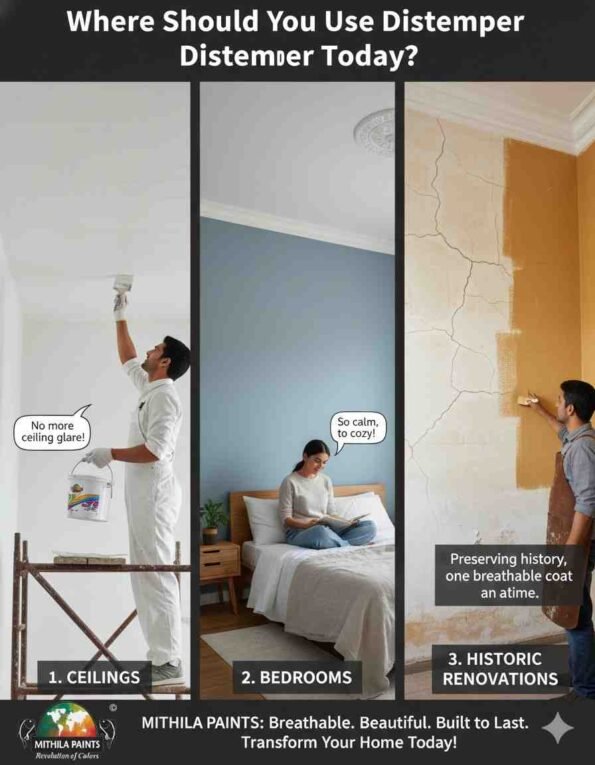
If you are sold on the beauty of this finish, here are the best places to use it in a modern home:
1. Ceilings
This is the most popular use for distemper today. Because ceilings aren’t touched, the “chalking” isn’t an issue. The ultra-matte finish hides imperfections in the plaster and prevents “glare” from light fixtures.
2. Bedrooms
The soft, calming aesthetic of distemper is perfect for a sleeping space. Since bedrooms are low-traffic, the paint will stay pristine for years.
3. Historic Renovations
If you own a listed building or a heritage property, distemper is often the only historically accurate (and safe) choice for the preservation of the masonry.
Common FAQs About Distemper Paint
Q: Is distemper paint the same as whitewash?
A: Not quite. Whitewash is a mixture of lime and water. Distemper uses chalk and a binder (glue). Whitewash is more caustic and is often used for exteriors or barns, while distemper is a finer interior finish.
Q: Can I buy colored distemper?
A: Yes! While traditional distemper was white or cream, you can add “earth pigments” (ochre, umber, sienna) to create stunning, deep colors. Many boutique paint companies now sell pre-mixed colored distempers.
Q: Is it expensive?
A: Raw ingredients are very cheap. However, if you buy designer pre-mixed distemper, it can be more expensive than standard paint due to the high-quality natural pigments used.
The Timeless Appeal of Distemper
So, what is distemper paint? It is more than just a bucket of pigment. It is a bridge to the past, a solution for the health of our homes, and a masterclass in interior aesthetics.
While it requires a bit more knowledge to apply and a bit more care to maintain, the result is a home that feels “alive.” In a world of mass-produced, plastic-coated surfaces, choosing distemper is a statement—a choice for quality, tradition, and environmental responsibility.
Whether you’re restoring a Victorian cottage or simply want the most beautiful matte ceiling in the neighborhood, distemper paint offers a depth and soul that modern chemistry has yet to beat.